How to Pay Off Student Loans Aggressively in 2025 (Fast Plan)
Want more freedom and less stress this year? You can crush your balance faster than you think.
In 2025, the average U.S. student loan sits around $39,000 to $42,000, and about 42 to 45 million people owe. This guide shows you how to pay off student loans aggressively without starving your budget.
You’ll get a simple, bold plan that mixes extra payments, smart budgeting, higher income, and smart use of programs like PSLF. It works for both federal and private loans.
We’ll focus on three wins, cut interest, shorten your timeline, and protect cash flow. Pick the tactics that fit your life, then stick with them. Your payoff date can move a lot closer.
Know Your Loans and Set a Bold Payoff Target

Aggressive payoff starts with clarity. Put all your loans on one page, then set a target you can attack every month. When you see the full picture, you make faster, cleaner moves. The goal for this section is simple: a one-page debt snapshot and a target payoff date.
Create a one-page snapshot of every loan
One page, every loan. Keep it tidy and visual. It should take 20 minutes, and it will speed up every decision you make.
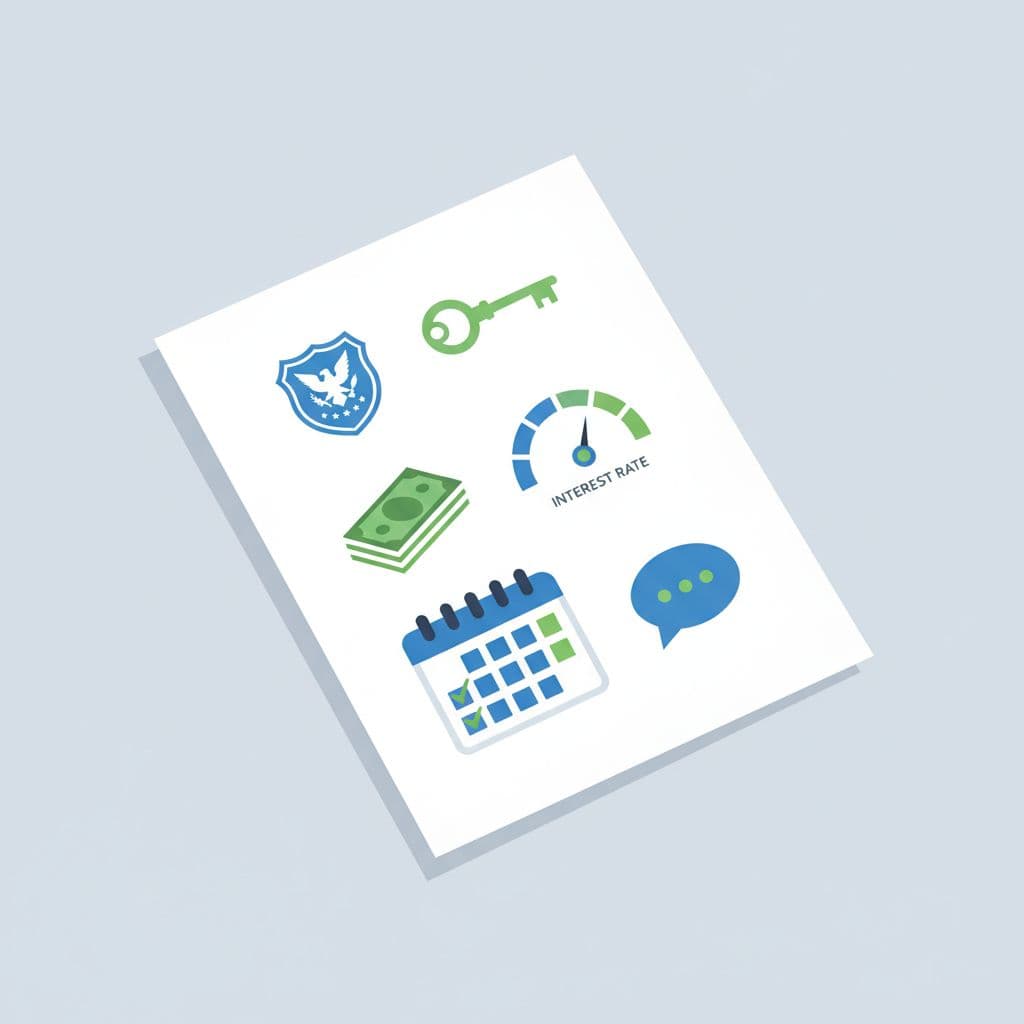
Here is what to list for each loan:
- Loan type: federal or private
- Servicer: who you pay
- Balance: today’s principal
- Interest rate: note if it is fixed or variable
- Minimum payment: the required monthly amount
- Due date: when the payment is due
- Special rules: IDR plan, PSLF, cosigner, variable-rate adjustments, autopay discount, refinance terms
Use studentaid.gov to pull all federal loan details. For private loans and old accounts, use a free credit report at AnnualCreditReport.com to confirm lenders and balances.
A simple template helps you see it at a glance:
| Loan nickname | Type | Servicer | Balance | Rate (F/V) | Minimum | Due date | Special rules |
|---|---|---|---|---|---|---|---|
| Unsub Stafford | Federal | AidCo | $8,200 | 5.5% (F) | $85 | 15th | On IDR, PSLF eligible |
| Refi 2022 | Private | LendPro | $17,400 | 7.2% (V) | $195 | 5th | 0.25% autopay discount |
| Parent PLUS | Federal | AidCo | $12,700 | 7.1% (F) | $145 | 1st | No PSLF, standard plan |
Now, guard against a quiet balance killer: interest capitalization. When unpaid interest gets added to your principal, you start paying interest on a bigger number. This often happens after forbearance or deferment, when you leave or fail to recertify an IDR plan, or when certain benefits end. Paying interest early, even small amounts, stops interest from piling on itself. Think of it like sweeping water away before it freezes into ice you have to chip off later.
Action steps to finish this snapshot fast:
- Download your federal data from studentaid.gov and list each loan as separate rows.
- Pull your free credit report and match private loans to current servicers.
- Add rates, minimums, and due dates from your latest statements.
- Flag any variable rates or forgiveness paths in Special rules.
Run the numbers to see how fast you can finish
Your payoff date is not fixed. A little extra each month brings it closer. The fastest way to see your timeline is to test a few extra payment amounts and compare the results.
- Biweekly payments: Pay half your monthly amount every two weeks. You will make 26 half-payments, which equals 13 full payments each year. That extra “13th” payment goes straight to principal.
- Start with a free payoff calculator: Most servicers have one, and there are many reliable free calculators online. Enter your balance, rate, and planned extra payment to see months to payoff and total interest.
Use this simple example so you can mirror it with your numbers:
- Starting point: $30,000 at 6.5% fixed, 10-year term. Standard payment is about $341 per month. Total interest over 10 years is about $10,860.
- Add $100 per month (pay $441): finish in about 7.1 years, interest about $7,700. You save roughly $3,100 and cut about 3 years.
- Add $200 per month (pay $541): finish in about 5.5 years, interest about $5,750. You save roughly $5,100 and cut about 4.5 years.
- Add $500 per month (pay $841): finish in about 3.3 years, interest about $3,400. You save roughly $7,400 and cut more than 6.5 years.
If you prefer biweekly, split your total monthly payment in half and schedule it every two weeks. The extra payment hits each year without you having to think about it.
Quick tip: always direct extra payments to principal on the specific loan you are targeting. Some servicers prepay future months by default. Change your setting or add a note with each payment.
Pick your attack order: avalanche or snowball
You need one target at a time. Keep minimum payments on all loans, then send every extra dollar to the target loan until it is gone. Choose your method below and commit.
- Debt avalanche: Pay the highest interest rate first. This saves the most money. It is best if your rates vary and you want maximum interest savings.
- Debt snowball: Pay the smallest balance first. This builds fast wins and momentum. It is best if motivation is your main hurdle or your balances are scattered.
When to use each method:
- Use avalanche if you have a private loan at a high rate, a variable rate that could rise, or a big gap between your rates. Your savings will be clear and large.
- Use snowball if stress is high and you need a quick win. Clearing one balance tightens your focus and frees a minimum payment you can roll to the next loan.
How to execute, step by step:
- List every loan with rate and balance.
- Pick avalanche or snowball.
- Sort your loans by your chosen method.
- Pay minimums on all loans.
- Send all extra cash to the top loan.
- When it is paid off, roll that full payment to the next loan on your list.
Set a bold payoff target now. Use your snapshot and the example above to pick a date, then reverse engineer the monthly extra you need. Put that number in your budget and make it automatic. Your plan just got real.
Aggressive Payment Tactics That Save the Most Interest
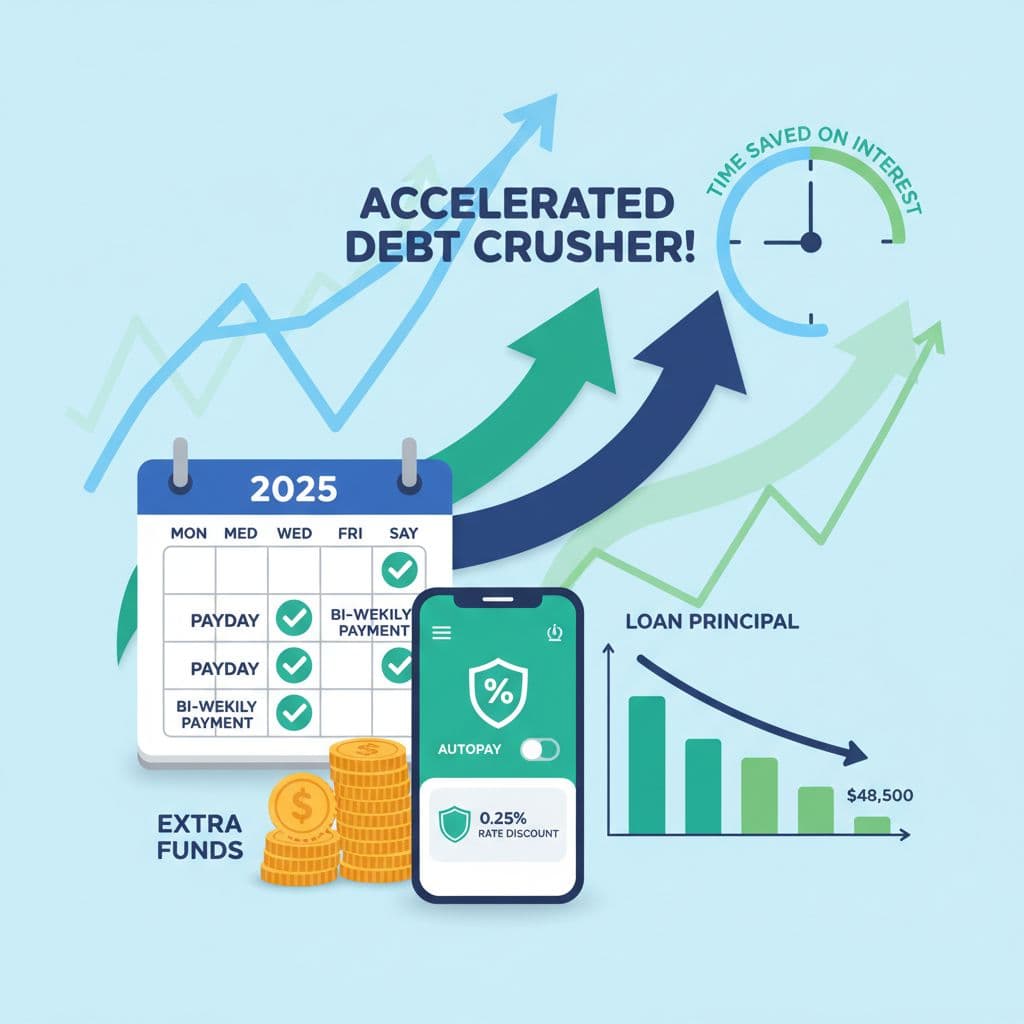
Speed comes from simple systems you can run on autopilot. Focus on three moves that cut interest, increase frequency, and direct every extra dollar where it matters most. Set them once, then let your momentum do the heavy lifting.
Automate payments, go biweekly, and target the principal
Automation saves time and interest. Most major servicers offer an autopay discount of about 0.25% on your rate when you enroll. That drop adds up over years, and it makes every payment hit on time.
Set up biweekly payments to match your paydays. You will make 26 half-payments in a year, which is the same as 13 full payments. That extra full payment reduces principal and trims months off your timeline.
Here is a clean way to set it up:
- Turn on autopay for at least the minimum due.
- Schedule an automatic transfer every two weeks that equals half your planned monthly total.
- If your servicer cannot do biweekly, use your bank’s bill pay on a biweekly schedule.
Direct extra money to principal on the loan you are attacking. Servicers often push overpayments to future due dates by default, which blunts your progress. Add this note to every extra payment or your account settings:
- Exact instruction to your servicer:
Apply extra to principal on Loan X, not future payments.
Two quick tips to maximize impact:
- Align with payday: set the transfer date for the day after you get paid.
- Name the target loan: highest rate first if you want the biggest savings.
Results you can expect:
- Payments hit more often, so less interest accrues between them.
- The autopay discount lowers total interest.
- Extra dollars crush principal instead of sitting as a prepaid balance.
Cut costs with a tight budget and protect a small emergency fund

A tight budget fuels your extra payments. Use a zero-based budget, where every dollar has a job. Pay essentials first, then debt, then wants. This keeps cash flowing to your top loan without guesswork.
Start with quick cuts you can put in place today:
- Subscriptions: cancel or pause for 90 days, track renewals in your calendar.
- Dining out: cap to one set meal per week, meal prep two batches on Sunday.
- Rideshare: swap short trips for transit or walking, group errands.
- Brand swaps: choose store brands for staples, rotate expensive items less often.
- Housing hacks: find a roommate, negotiate rent at renewal, list a parking spot, or sublet a room for short-term events.
Protect a small buffer so you do not swipe a card for surprise bills. Target $500 to $1,000 in a simple savings account. This is your pothole fund, not a long-term stash. Refill it after any dip, then keep pressing on the loans.
A simple budget flow that works:
- Essentials, like rent, utilities, food, transport.
- Minimums on all loans.
- Extra to your target loan.
- Wants last, with a fixed limit.
Small changes stack up. Even trimming $10 here and $20 there can free $150 to $300 a month. That money, on autopilot, can cut years off your payoff.
Throw windfalls at your highest-priority loan
Windfalls are your fast-forward button. Send them straight to principal on your target loan the day they hit your account. The earlier the payment, the less interest accrues afterward.
Good windfall sources:
- Tax refunds
- Work bonuses or commission spikes
- Cash gifts
- Side hustle checks
- Expense reimbursements that came in lower than expected
Keep it strict to avoid lifestyle creep. Before the deposit lands, decide the split. For example: 90 percent to principal, 10 percent to a small treat. You get a quick win and still crush balance.
Why this works, even in small amounts:
- $50 chunks sent weekly knock down principal often.
- Frequent hits reduce average daily balance, so interest shrinks.
- Momentum builds, which keeps you engaged when motivation dips.
How to execute without friction:
- Create a separate “loan attack” sub-account at your bank.
- Auto-transfer windfalls there on payday.
- Once a week, send the total as an extra payment with this note:
Apply extra to principal on Loan X, not future payments.
Simple, fast, and focused. Keep the pipeline of extra payments flowing, and your interest bill will keep shrinking.
Make More Money So You Can Pay Off Loans Faster

More income is the fastest way to move your payoff date. Stack quick wins you can start this week, then route every extra dollar to your target loan. Keep it simple, flexible, and focused.
Aim for an extra $300 to $800 each month. Treat it like a separate paycheck for your loans. Set aside 25 percent of side income for taxes so there are no surprises later.
Side hustles you can start this week
Start with options that fit your schedule and local demand. Pick one, launch in 48 hours, then add a second if you want more speed.
| Hustle | How to start fast | Time needed weekly | Typical monthly range |
|---|---|---|---|
| Rideshare | Sign up, pass checks, drive peak hours | 6 to 12 hours | $300 to $700 |
| Food delivery | Deliver dinner rush, stack batches | 5 to 10 hours | $250 to $600 |
| Tutoring | Offer math, writing, or test prep online | 3 to 6 hours | $300 to $800 |
| Freelance writing/design | Create simple gigs on marketplaces | 4 to 8 hours | $300 to $900 |
| Virtual assistant | Inbox, scheduling, basic admin tasks | 4 to 8 hours | $300 to $700 |
| Sell items online | List fast movers, ship twice a week | 2 to 5 hours | $150 to $500 |
| Pet sitting/dog walking | Weekend sits, weekday walks at lunch | 3 to 6 hours | $250 to $600 |
Quick launch tips that keep money flowing:
- Rideshare/Delivery: work Friday dinner, Saturday night, and Sunday lunch. Those windows pay better.
- Tutoring: post a simple bio, offer a free 15-minute intro, and set a clear syllabus.
- Freelance: start with small fixed projects, like blog posts or one-page graphics, to earn fast reviews.
- Virtual assistant: pitch busy solo businesses, like realtors or coaches, with a 10-hour starter package.
- Selling items: start with clothes, tech, books, and small furniture. Take clear photos in good light.
- Pet care: book repeat clients. Bundle walks in the same neighborhood to stack income per hour.
Money rules for side work:
- Target: $300 to $800 per month within 2 to 4 weeks.
- Taxes: set aside 25 percent of side income in a separate savings account.
- Payments: every Friday, send the net amount to your top loan and mark it as principal.
Example you can mirror: earn $500 this month from delivery and tutoring. Save $125 for taxes. Send $375 to principal on your highest-rate loan. Repeat next week.
Ask for a raise or more hours with a simple script

Better pay at your main job can beat any side hustle. Time your ask around annual or midyear reviews, or right after a big result lands.
Use this short script. Keep it calm and direct:
- “I wanted to share a few wins from the last quarter. I led [project], which increased [metric] by [result]. I also [second win] and [third win]. Based on this impact, I am asking to move my pay to [target number]. How does that align with the team’s budget and timeline?”
- If pushback comes: “What would make that number a yes? I am open to a phased plan or a performance bonus tied to [metric].”
- If a raise is not possible now: “Can we discuss overtime, extra shifts, or a stretch project that comes with additional pay?”
Smart timing and add-ons:
- Book the meeting two weeks before your review, not after it.
- Bring one page with your wins, measured in dollars, time saved, or outcome.
- If pay is locked, ask for overtime, shift swaps, or on-call hours as a bridge.
Set a simple goal: increase monthly take-home by $200 to $400. Lock that extra into your biweekly loan plan and never touch it.
Sell items and trim recurring bills
Cash from your closet and a few calls can fund your next extra payment. Knock this out in a weekend and keep the momentum going.
Sell your stuff with a fast system:
- Pick 10 items that will move, like jackets, jeans, sneakers, small electronics, books, or decor.
- Take photos near a window, clean background, and multiple angles.
- List on two apps at once. Price a touch higher than your floor to leave room for offers.
- Pack supplies ahead of time. Ship within 24 hours for better ratings.
Cut recurring costs that drain cash every month:
- Call your internet and phone providers. Ask for promo pricing or loyalty rates. If they refuse, schedule a switch.
- Shop auto and renters insurance. Ask about usage-based, bundling, or higher deductible options.
- Cancel or pause memberships you do not use. Look for annual renewals and set reminders 10 days before each one.
- Remove add-ons on streaming. Share a plan with family if the terms allow.
Direct every dollar to your target loan:
- Create a “bill savings” note in your budget with the monthly amount you freed.
- Auto-transfer that exact amount to the loan the day after your due dates.
- Mark each extra payment as principal on the target loan.
Small wins stack fast. Sell three items for $120, cut $45 from your phone plan, and cancel $30 of unused apps. That is $195 this month. Send it to principal and watch your timeline shrink.
Refinance, Consolidate, or Use Forgiveness the Smart Way

Your payoff plan gets stronger when you match the right tool to the right loan. Private loans respond well to rate cuts. Federal loans shine with certain protections and forgiveness tracks. Choose with intent, protect your options, and you will save time and money.
A quick guide for direction:
- Refinance to cut a high private rate.
- Consolidate to simplify and unlock federal program access.
- Use forgiveness if your job or income path fits.
Should you refinance your student loans?
Refinancing can drop your interest rate, shrink your total cost, and speed up payoff. It works best when you have strong credit, a steady income, and a clear plan.
Before you apply, sort your loans:
- Best targets: high-rate private loans, variable-rate private loans that could rise, small leftover private balances at steep rates.
- Think twice: federal loans that may qualify for an income-driven plan or forgiveness. Refinancing a federal loan into a private loan removes those protections for good.
Key checks to make:
- Shop multiple lenders: use prequalification to compare real offers without a hard pull.
- Fixed vs variable: fixed rates are stable; variable rates may start lower but can climb.
- Fees and terms: look for zero origination fee, no prepayment penalty, and clear cosigner release rules.
- Discounts: autopay often knocks 0.25 percent off your rate.
Smart steps to lock value:
- Separate federal from private loans on your list.
- Refinance only the private loans with the worst rates first.
- Choose the shortest term you can afford to keep interest low.
- Set autopay on day one and keep extra payments going to principal.
Clear warning: when you refinance federal loans into private, you lose income-driven repayment, one-time account fixes, and forgiveness programs. Once you cross that bridge, you cannot go back.
When to consolidate federal loans
Direct Consolidation lets you combine federal loans into one new Direct Consolidation Loan. You get one payment and can make some loans eligible for PSLF or an IDR plan.
Good reasons to consolidate:
- Program eligibility: older FFEL or Perkins loans need consolidation to qualify for PSLF or certain IDR plans.
- Simplified payments: one servicer, one due date, less room for error.
- Parent PLUS path: consolidation can open access to the ICR plan, which is required for any PSLF track on Parent PLUS debt.
Important tradeoffs to note:
- Payment counts can reset: consolidating can reset PSLF or IDR progress on some loans. If you are partway to 120 PSLF payments, be careful and confirm how counts will carry over.
- Interest capitalization: unpaid interest can roll into principal at consolidation, which increases your balance.
How to consolidate the right way:
- Check PSLF or IDR rules for each loan before you combine anything.
- If working toward PSLF, confirm your qualifying payment count status first.
- Consolidate only the loans that need it for eligibility or simplicity.
- Keep proof of all prior payments and your employment certifications.
Forgiveness programs you should check
Forgiveness can erase the balance you do not need to pay. If your work or pay fits these programs, build your plan around them, then attack any private or high-rate debt on the side.
- Public Service Loan Forgiveness (PSLF): 120 qualifying payments while working full time for a government or 501(c)(3) nonprofit. Use a qualifying IDR plan and submit annual employment certification. Avoid missed certifications, wrong loan types, and non-qualifying plans.
- Common mistakes to avoid: missing employer certification, using the wrong repayment plan, or pausing payments without checking if it counts.
- Teacher Loan Forgiveness: up to $17,500 after five full and consecutive academic years at eligible low-income schools or certain educational service agencies. Check your subject area and license status.
- IDR forgiveness: balance forgiven after 20 to 25 years of payments on an income-driven plan, based on the plan and loan type. Payments are tied to income, so your cash flow stays flexible while you pay.
Tax note for 2025:
- Federal taxes on forgiven student loans are waived through 2025 under current law. State taxes may still apply depending on where you live. If forgiveness lands this year, plan for zero federal tax, then check your state rules.
Quick action checklist:
- Confirm your employer type and loan types on studentaid.gov.
- Enroll in a qualifying IDR plan if you are pursuing PSLF or IDR forgiveness.
- File employment certification for PSLF every year and when you change jobs.
- Track qualifying payments and keep copies of statements.
Mix strategies to fit your life
You do not need a single lane. Blend tactics that match your job, rates, and risk tolerance. Keep what helps, drop what slows you down.
If you are going for PSLF:
- Keep federal loans on a qualifying IDR plan to maintain eligibility.
- Make minimums on those loans, then throw extra cash at private or highest-rate loans first.
- Refinance private loans if you can cut the rate and keep a short term.
If PSLF is not on the table:
- Refinance high-rate private loans and use the debt avalanche method.
- Keep federal loans on the plan that fits your cash flow, then target the highest rate with every extra dollar.
- Review fixed versus variable rates each quarter and adjust if offers improve.
Revisit your plan every quarter:
- Rates: check if new refinance offers beat your current rate by at least 1 point or shorten the term.
- Eligibility: confirm IDR and PSLF rules for any job move or life change.
- Payments: roll freed-up minimums to the next target loan the moment one is paid off.
Example mix that works:
- You work at a nonprofit, have two federal loans and one private at 9 percent. Keep federal loans on IDR, certify employment yearly, and send all extra cash to the 9 percent private loan. When that private loan is gone, funnel that full payment into your federal loans while PSLF counts continue.
Stay flexible, but do not drift. Choose the lane that pays you the most, then run it hard.
Stay Motivated, Avoid Mistakes, and Protect Your Progress
Aggressive payoff is not only about dollars. It is about momentum, clean execution, and guardrails that protect your work. Use simple systems that keep you fired up, avoid common traps, and help you push through hard months without breaking your plan.

Track wins and celebrate milestones
Progress needs to be visible. When you can see it, you chase it.
- Use a wall chart or app: create a grid with boxes for each $500 or $1,000. Color a box every time you cross a mark. Keep it where you see it daily.
- Set low-cost rewards: a favorite meal, a fancy coffee, a rented movie night, a new playlist, a free local hike. Keep rewards small and fast so you do not slow cash flow.
- Keep a debt-free countdown: write your target date on your calendar. Update it monthly as your timeline moves in. Watching the date shrink boosts drive.
Make it fun and concrete:
- Pick a color for each loan. When a loan is gone, retire the marker.
- Add a tiny sticker for every principal-only payment. Stickers seem silly, but they work.
A simple milestone plan you can copy:
| Milestone paid | Quick reward | Time to complete |
|---|---|---|
| $500 | Favorite takeout at home | 2 to 4 weeks |
| $1,000 | A new book or workout class | 3 to 6 weeks |
| $2,500 | Day trip or museum ticket | 1 to 3 months |
| $5,000 | Nice dinner with a friend | 3 to 6 months |
Keep those rewards on a budget line so you never undercut your payoff. Aim for 5 to 10 percent of each milestone, then send the rest to principal.
Avoid common pitfalls that slow you down
Small errors can add months. Tighten a few habits and keep your plan fast.
- Direct extra to principal: servicers often apply overpayments to future due dates. In your account settings, add this instruction on every extra payment:
Apply extra to principal on Loan X. Do not advance due date.Take a quick screenshot after each payment. - Target the right loan: choose the exact loan ID when you pay. Many accounts have multiple sub-loans. Pick the one at the top of your list, then verify it posted there.
- Watch forbearance: it can help in a true crunch, but interest may keep accruing. When it ends, that interest can capitalize and raise your principal. If you need help, try an income-driven plan before forbearance.
- Track variable rates: if a private loan has a variable rate, set a calendar alert for each rate reset. If it climbs, consider refinancing or moving it to the top of your avalanche list.
- Protect autopay after servicer transfers: when loans move, autopay can drop. Log in the day you get a transfer notice, confirm due dates, and re-enable autopay. Print or save the first new statement for proof.
Two quick safety checks each month:
- Confirm that last month’s extra payment hit principal on the right loan.
- Compare your current balance to your tracking sheet. The lines should match.
If money gets tight, shift but do not stop
Life happens. Your goal is to keep your streak alive, guard your credit, and hold momentum.
- Keep minimums: always pay at least the minimum on time. This protects your credit and keeps late fees away.
- Pause extras: stop principal-only payments for a month or two. Cut deeper on costs or add a short burst of income.
- Use an income-driven plan for federal loans: if income drops, file or recertify early. Lower payments can keep you current and preserve benefits.
- Call your servicer early: the moment you see a problem, ask about options. Note the rep’s name, date, and the plan. Save any written confirmations.
Fast ways to free cash within 48 hours:
- Pause two subscriptions and one delivery app.
- Switch two nights of takeout to meal prep.
- List three items for sale and ship within a day.
- Add one extra shift or a weekend gig this week.
Your motto here: adjust the throttle, not the path.
A simple 12-month aggressive payoff roadmap
This roadmap stacks motivation, clean execution, and speed. Follow it as written or tweak the numbers to fit your life.
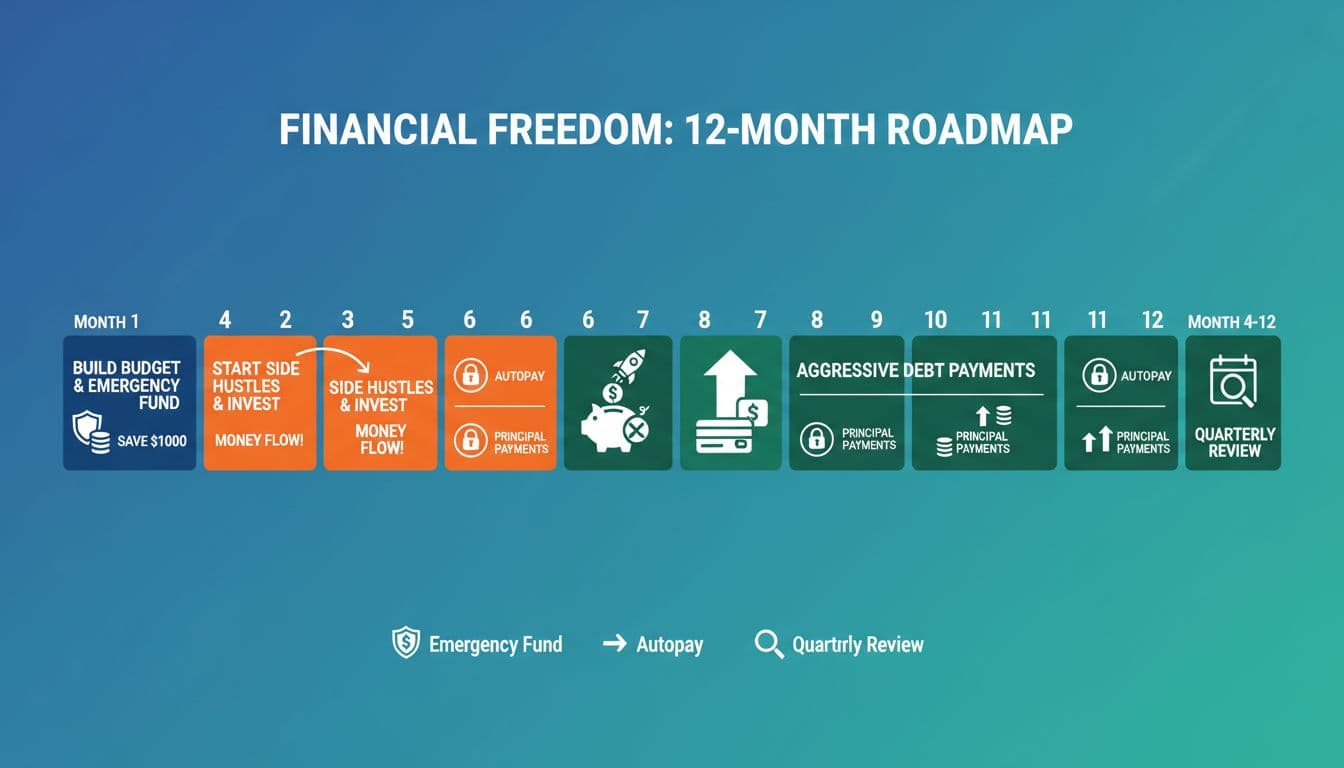
- Month 1: get set and build a small buffer
- Create a one-page loan snapshot with rates, balances, and minimums.
- Build a zero-based budget and set a fixed extra payment target.
- Seed a $500 to $1,000 emergency fund in a high-yield savings account.
- Add a wall chart or app tracker. Pick your milestone rewards now.
- Months 2 to 3: automate and boost income
- Turn on autopay for minimums, then set biweekly transfers for your total.
- Choose avalanche for max savings or snowball for momentum, then sort your list.
- Start a side hustle you can run weekly. Route earnings to principal every Friday.
- Add the payment note in your account:
Apply extra to principal on Loan X.
- Months 4 to 12: press the gas and review often
- Send all extra cash to your target loan. Keep minimums on the rest.
- Throw windfalls at principal the day they hit, even small ones.
- Review rates and programs each quarter. If a variable rate rises, move that loan up. If a refinance offer cuts your rate and term, run the numbers and switch.
- After each payoff, roll the entire freed payment to the next loan within 24 hours.
- Keep the countdown current. Celebrate each $1,000 with a simple, planned reward.
Weekly rhythm that keeps you on track:
- Monday: quick budget check and transfer half-payment.
- Friday: send side hustle or savings wins to principal.
- End of month: reconcile balances, update the wall chart, and pick next micro-goal.
You are building a habit that compounds. Wins are visible, traps are avoided, and your timeline gets shorter every month. Keep the plan simple, protect your progress, and let your momentum carry you to the finish.
FAQs
Straight answers to the questions people ask most when they want to pay off student loans fast. Use these to clear roadblocks and keep your plan moving.

What is the fastest way to pay off student loans in 2025?
Speed comes from three habits that stack results:
- Pay more than the minimum, every month.
- Switch to biweekly payments, which creates one extra full payment per year.
- Turn on autopay for a rate discount, usually about 0.25 percent.
Direct every extra dollar to principal on your target loan. Do not let the servicer advance your due date instead.
Should I pay off federal or private loans first?
Most people start with private loans, especially if the rate is higher or variable. Keep federal loans on the best-fit repayment plan for your cash flow. If you work in public service or a qualifying nonprofit, protect PSLF eligibility and focus extras on private or highest-rate debts.
Avalanche or snowball, which pays off loans faster?
- Avalanche (highest rate first) saves the most interest.
- Snowball (smallest balance first) creates faster wins.
Pick one method and stick with it. If your rates vary a lot, avalanche usually wins. If motivation is the issue, start with snowball to build momentum.
Should I refinance or consolidate my loans?
Refinance and consolidation solve different problems. Here is a quick guide:
| Move | What it does | Best for | Big tradeoff |
|---|---|---|---|
| Refinance | Replaces loans with a new private loan | Cutting high private rates | Lose federal perks if you refinance them |
| Consolidate | Combines federal loans into one Direct loan | PSLF or IDR eligibility, simplicity | Possible payment count resets |
Refinance only when the new rate and term clearly beat your current setup. Do not refinance federal loans if you need PSLF or IDR protections.
How much of my income should go toward loans for an aggressive plan?
A strong target is 10 to 20 percent of take-home pay while you are in attack mode. If you can hold 15 percent for a year, you will see big progress. Protect a small emergency fund first, so you do not swipe a card for surprise bills.
Do biweekly payments really help?
Yes. Paying half every two weeks leads to 13 full payments each year. That extra payment hits principal and reduces interest that accrues between monthly due dates. It is simple and it works with steady paychecks.
What should I do with a bonus or tax refund?
Send most of it to principal on your target loan the day it hits. A good split is 90 percent to loans, 10 percent for a treat. Early lump sums cut interest the rest of the year. Always include a note to apply the money to principal, not future payments.
Will aggressive payoff hurt my credit score?
Your score usually holds steady or improves if you:
- Pay on time, every time.
- Keep accounts open and in good standing.
- Avoid maxing credit cards while you attack student debt.
Scores can dip a little when you close a large loan, then settle. On-time history matters more.
Is it smart to pay off loans before saving for retirement?
Balance both when you can. A simple rule:
- Grab any 401(k) match first, since that is free money.
- Then attack high-interest loans.
- If your loan rates are low and you have access to strong retirement matches, split your focus. You can win on both fronts.
What if I qualify for PSLF, should I still pay extra?
If PSLF is your path, keep your federal loans on a qualifying IDR plan and make minimums. Put extra cash toward private or highest-rate loans instead. Do not speed up loans that will be forgiven if you stay eligible.
Are employer student loan benefits worth it?
Yes. Many employers offer tax-free help up to $5,250 per year and some match loan payments through retirement plans. Ask HR for program details, enrollment windows, and how payments are sent. Treat this as free acceleration on your payoff.
Can I switch repayment plans while I am paying aggressively?
You can. For federal loans, you can move to an income-driven plan if your income drops or if you need PSLF eligibility. For private loans, options are limited, so talk to your lender early. Keep extras flowing to principal once your base payment is set.
Do I need an emergency fund if I am paying loans fast?
Yes. Keep $500 to $1,000 in a simple savings account. This is your pothole fund for small hits, like a flat tire or copay. Refill it after a dip. Then press the gas on your top loan again.
What happens to my interest if I pause payments?
During forbearance or some deferments, interest often keeps accruing. When it capitalizes, it gets added to your principal. That means you pay interest on a larger balance later. If you need help, consider an income-driven plan before pausing.
Are taxes due on forgiven student loans in 2025?
Under current law, federal taxes on forgiven student loans are waived through 2025. State taxes may apply, depending on where you live. If forgiveness is likely this year, plan for zero federal tax, then check your state rules.
How do I make sure extra payments go to principal?
Use this exact note with every extra payment: Apply extra to principal on Loan X, do not advance due date. After the payment posts, verify it hit the correct sub-loan. Take a quick screenshot for your records.
What if I have a variable-rate private loan?
Set alerts for each rate reset. If the rate climbs, move that loan to the top of your list or refinance if you can secure a lower fixed rate. High and rising rates are the most expensive to carry.
Is it safe to add a cosigner to refinance?
A cosigner can unlock a lower rate. Make sure the lender has a clear cosigner release policy after a set number of on-time payments. If you miss payments, your cosigner is on the hook, so treat the new loan with extra care.
How often should I check my payoff plan?
Review quarterly. Look for:
- Better refinance offers that cut the rate or term.
- PSLF or IDR updates that affect your federal strategy.
- Servicer changes that could turn off autopay.
Small tweaks each quarter can save thousands over the life of your loans.
Conclusion
You have a clear path to pay off student loans aggressively. Build momentum with automation, targeted extra payments, smart order of attack, and a few well-timed income boosts. Protect federal benefits when they help, refinance high-rate private loans when they do not, and keep your system simple so it runs every week.
Start now. Set up autopay, then make a $50 principal-only payment today. Pick a debt-free date, write it down, and share your plan with a friend for accountability. Small, steady hits change the math faster than you think. Stay hungry, keep cash aimed at principal, and watch your finish line move closer.